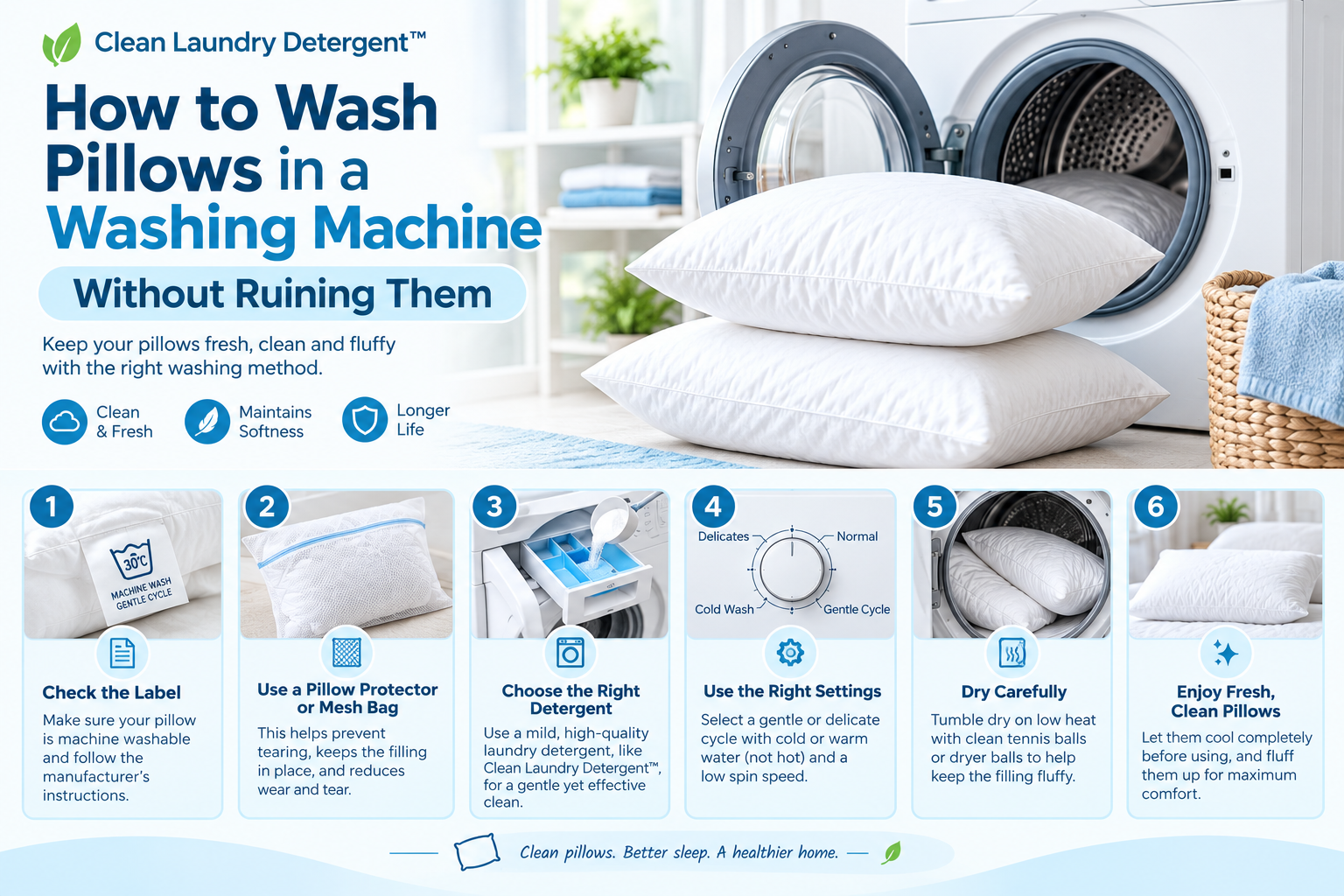
How to Wash Pillows in a Washing Machine Without Ruining Them
Knowing how to wash pillows in a washing machine can save you money and make your bed feel brand new. Over time, pillows collect sweat, skin oils, dust mites, and allergens, and they slowly turn yellow and flat. The good news is that most pillows can be washed at home. The catch is that the wrong cycle, too much detergent, or a rushed drying job can leave you with a lumpy, soggy mess. This guide walks you through exactly how to wash pillows the right way, for every pillow type.
Quick answer: Most down, feather, and polyester pillows can be machine washed. Wash two pillows at a time to balance the load, use a gentle cycle with warm water and a small amount of mild detergent, run an extra rinse, then dry on low heat with dryer balls until fully dry. Memory foam and latex pillows should never go in the washing machine.
Can You Wash All Types of Pillows in a Washing Machine?
Short answer: no. Whether you can wash pillows in the washing machine depends on what is inside them. Always read the care label first, since it is the most reliable guide for your specific pillow.
Pillow type
Machine washable?
Notes
Down
Yes (usually)
Gentle cycle, mild detergent, dry thoroughly on low heat
Feather
Yes (usually)
Same as down; can be heavier and slower to dry
Polyester / fiberfill
Yes
Easiest to wash; check the label for temperature limits
Memory foam
No
Spot clean or hand wash only; air dry flat
Latex
No
Spot clean only; keep away from direct heat
Buckwheat / microbead
No (wash cover only)
Remove the filling and wash the cover separately
How Often Should You Wash Your Pillows?
A good rule of thumb is to wash your pillows every 3 to 6 months. If you have allergies, sleep hot, eat or drink in bed, or share your bed with pets, wash them closer to every 3 months.
A simple routine keeps pillows cleaner for longer:
Pillowcases: weekly
Pillow protectors: every 1 to 2 months
Pillows: every 3 to 6 months
Before You Start: What You Need
Your pillows and their care labels
Mild liquid detergent (free of bleach and heavy fragrance)
A front-loading washer, or a top-loader without a center agitator
Two or three clean dryer balls or tennis balls
A stain remover or white vinegar for yellow patches (optional)
Tip: Check the seams and fabric before washing. If you see tears or loose stitching, mend them first or the filling can leak and clog your machine.
How to Wash Pillows in a Washing Machine: Step by Step
Read the care label. Confirm the pillow is machine washable and note the maximum water temperature.
Remove pillowcases and protectors. Wash these separately.
Pre-treat stains. Dab a small amount of detergent or stain remover onto stained areas and let it sit for 10 to 15 minutes.
Load two pillows at once. This balances the drum so the machine does not shake or go off-balance. If you only have one pillow, add a couple of clean towels to even out the load.
Add a small amount of mild detergent. Use about half of what you would use for a normal load. Too much soap is hard to rinse out and leaves pillows stiff or clumpy.
Choose a gentle cycle. Use warm water unless the label says otherwise.
Run an extra rinse. Pillows hold on to detergent, so a second rinse helps remove all of it.
Run an extra spin. This removes as much water as possible and speeds up drying.
Dry thoroughly. See the drying section below. Never use a pillow that is still damp inside.
What Temperature Should You Wash Pillows At?
For most pillows, warm water on a gentle cycle cleans well without damaging the filling or fabric. Cold water is a safe choice for delicate pillows or when the label recommends it. Hot water can shrink some fabrics and damage certain fillings, so only use it if the care label allows it. Some synthetic pillows tolerate hotter water, which can help reduce dust mites.
Best Detergent for Washing Pillows
Look for a mild, liquid detergent that rinses clean. For down and feather pillows, a gentle or down-specific wash helps protect the natural oils in the feathers. Avoid:
Bleach: it can weaken fabric and damage filling.
Fabric softener: it coats fibers and can make pillows flat and less breathable.
Heavy fragrances and harsh additives: these can linger and irritate sensitive skin.
If you have sensitive skin or allergies, choose a fragrance-free, hypoallergenic formula.
How to Wash Pillows by Type
How to Wash Down Pillows
Down pillows are delicate but wash well when handled gently. Use a mild detergent, a gentle cycle with warm water, and an extra rinse. Dry on low heat with dryer balls, and expect drying to take a while. Down must be completely dry or it can develop a musty smell.
How to Wash Feather Pillows
Feather pillows follow the same process as down. They tend to be heavier and may need more drying time. Fluff them by hand every 30 minutes during drying to prevent clumping.
How to Wash Polyester and Fiberfill Pillows
Polyester pillows are the most forgiving. A warm gentle cycle with mild detergent and an extra rinse works well. Dry on low to medium heat with dryer balls. Because synthetic fill can flatten over time, these pillows usually need replacing sooner than down.
How to Wash a Memory Foam Pillow
Do not machine wash memory foam. The agitation can tear the foam, and the foam soaks up water and may never dry properly, which leads to mold and odor.
Instead:
Remove the cover and wash it according to its own care label.
Spot clean the foam with a damp cloth and a little mild detergent.
If it needs a deeper clean, hand wash in lukewarm water and gently press (do not wring or twist) to release dirt.
Rinse by pressing out soapy water repeatedly, then press out as much water as you can with a towel.
Air dry flat, away from direct sunlight and heat, flipping it occasionally. This can take a day or more.
How to Remove Yellow Stains From Pillows
Yellow stains come from sweat and body oils soaking into the fabric over time. To tackle them:
Pre-treat the stain with a stain remover or a paste of mild detergent and water.
Let it sit for 15 to 30 minutes.
Wash as normal. Adding about a cup of white vinegar to the rinse can help with odor and stubborn residue.
Dry completely and check the stain. If it remains, repeat the process once before giving up.
Deep, set-in yellowing that does not lift after washing is often a sign the pillow is due for replacement. Using a pillow protector going forward helps prevent it from coming back.
How Do You Dry Pillows So They Don’t Get Lumpy?
Drying is where most people ruin their pillows. Take your time with this step.
Dry on low heat. High heat can melt synthetic fill and scorch feathers.
Add two or three dryer balls or clean tennis balls to keep the filling moving and break up clumps.
Pause every 30 minutes to take the pillows out, fluff them, and redistribute the filling.
Expect it to take 2 to 4 hours or more, and longer for down and feather.
Make sure the pillow is completely dry before use. Squeeze it in several spots and smell it. Any dampness or musty odor means it needs more time.
If you prefer to air dry, lay the pillow flat on a clean towel or drying rack in a well-ventilated spot, and fluff it often. Outdoor drying in shade or indirect sun works well, but it takes longer.
Can You Put Pillows in the Dryer?
Yes, down, feather, and polyester pillows can go in the dryer on low heat. Memory foam and latex pillows cannot, since heat damages the foam. When in doubt, check the care label, and when still in doubt, air dry.
How Do You Know When to Replace a Pillow Instead of Washing It?
Washing can refresh a pillow, but it cannot bring a worn-out one back to life. It is time to replace your pillow if:
It stays flat or lumpy even after washing and fluffing.
It fails the fold test: fold it in half, and if it does not spring back, the support is gone.
It keeps a bad smell after washing.
It has deep yellow or dark stains that do not lift.
It is causing neck pain, stiffness, or increased allergy symptoms.
As a general guide, synthetic pillows last about 1 to 2 years, memory foam around 2 to 3 years, and good-quality down or feather pillows several years with proper care.
Common Mistakes That Ruin Pillows
Washing a single pillow alone, which unbalances the machine
Using too much detergent
Using fabric softener or bleach
Skipping the extra rinse
Drying on high heat
Using a pillow that is not fully dry
Putting memory foam in the washer or dryer
Frequently Asked Questions
Can you wash all types of pillows in a washing machine?
No. Down, feather, and polyester pillows are usually machine washable, but memory foam and latex are not. Always check the care label first.
How often should you wash your pillows?
Every 3 to 6 months. Wash pillow protectors every 1 to 2 months and pillowcases weekly.
What temperature should you wash pillows at?
Warm water on a gentle cycle works for most pillows. Use cold for delicate ones and avoid hot water unless the label allows it.
How do you dry pillows so they don’t get lumpy?
Dry on low heat with dryer balls or tennis balls, fluff the pillows every 30 minutes, and make sure they are completely dry before use.
How do you know when to replace a pillow instead of washing it?
Replace it if it stays flat, lumpy, smelly, or deeply stained after washing, or if it does not bounce back when folded in half.
Final Thoughts
Washing your pillows is easy once you know the right method. Check the label, use a gentle cycle with a little mild detergent, rinse well, and dry thoroughly with dryer balls. Do this every few months and pair it with a pillow protector, and your pillows will stay fresh, fluffy, and hygienic for much longer.